
18 double-decker sightseeing buses belonging to Willms Touristik have been converted from diesel to electric; the modernised powertrains comprise of 145 kW electric motors coupled to Allison T280R fully automatic transmissions.
Cologne, Germany, August 2025 – German sightseeing tour specialist, Willms Touristik, has converted 18 of its ‘CityTour’ fleet of MAN convertible double-decker buses from diesel to electric. Thanks to a multi-million Euro grant from the German Federal Ministry for Digital and Transport’s ‘Retrofit electric mobility in urban public transport’ programme,’ the buses now run almost silently around the centres of Cologne and other German cities.
The converted buses comprise six different models on MAN chassis, ranging from 37-year-old MAN SD202s (built between 1988 and 1990) to modern Euro 6 buses from 2016 to 2019. The conversion was carried out by Banke ApS, a Danish specialist company, in close cooperation with Allison authorised distributor, DGS Diesel- und Getriebeservice GmbH from Mainz, Germany.
First of all, the vehicles were completely stripped down: The entire diesel powertrain including combustion engine, exhaust system, fuel tanks and conventional transmission were removed. Following a rigorous inspection of the chassis, the new electrical components were installed. The heart of the drive is a DANA TM4 SUMO HP electric motor delivering 145 kW and 625 Nm in continuous operation.
Power is transmitted by the fully automatic six-speed T280R Allison Transmission. Allison’s Continuous Power Technology™ means the buses accelerate smoothly and provide tourist passengers with a jolt-free journey. The transmission was adapted specifically for use in electric buses, to optimise the electric motor and increase the efficiency of the overall system.
Six lithium iron phosphate battery packs with a total storage capacity of 240 kWh enable a range of around 200 kilometres (approx. 124 miles), which covers the daily mileage of each tour bus. Since the buses have an open top deck and the batteries could not be placed on the roof, each vehicle has six battery packs fitted in the rear as well as in the passenger compartment. Depending on the bus model, this eliminates between two and six passenger seats.
Conversion to Electric: The Right Decision
Bus operator Sascha Willms is highly satisfied with his ‘new’ electric buses and particularly the driving comfort and robustness of the Allison transmissions, in what is a demanding application: “The acceleration is smooth, the manoeuvrability is excellent and there are no jolts when shifting gears. I also anticipate that beyond the fully hydraulic transmission, the electric drive will eliminate wear and tear and high maintenance costs for the components. We deliberately decided against a gearless direct drive and instead selected a drive system that has already proven itself in the municipal sector, in vehicles for refuse collection.”
Karsten Flamming, executive assistant at Willms, notes: “The fully automatic transmission ensures a greater range and fewer charging stops. Without a transmission, the electric motor would run at a constant high speed and consume significantly more electricity. The Allison transmission shifts automatically so that the engine runs at lower speeds, hence allowing us to be more energy-efficient while driving.”
Although converting existing buses is significantly cheaper than purchasing new vehicles, Willms would not have been able to convert its double-decker fleet to electric drive without the government funding. “It was only thanks to this funding programme that our company was able to convert so many buses to electric drive in such a short space of time. 80 per cent of the conversion costs are covered by the Federal Ministry for Digital and Transport. We at Willms Touristik are bearing the remaining cost of around 2.2 million euros – including setting up the charging infrastructure, driver training and further training for our workshop staff. That may sound like a large sum, but we didn’t have to buy any new buses and instead we now have a modernised fleet that will be running for many years to come.”
The benefits of the conversion are not purely economic. Local pollutant emissions have been reduced and resources have been saved with no new vehicles needing to be built. Energy costs for electric buses are around 45% lower than for diesel buses. Especially when travelling on highways, energy consumption is low at only about 0.75 kWh per kilometre. Willms calculates an average energy consumption of 1.1 kWh per kilometre. This is around 0.33 euros per kilometer in electricity costs compared to around 0.60 euros per kilometre, previously, with diesel.
The new electric buses run much more quietly and with less vibration than their diesel-powered predecessors. The noise level has been reduced by up to 10 decibels. As there is no annoying engine hum, passengers can hear the explanations through their headphones much better.
August 29th 2025
About Willms Reisen
Willms Touristik was established in 1947 and operates several coaches and long-distance buses for passenger transportation. In recent years, the city tour segment has developed into an important part of the business. Currently 31 double-decker convertible buses are in operation for city tours under the Citytour brand in Cologne, Düsseldorf, Bonn, Aachen, Dortmund, Hanover, Heilbronn, Karlsruhe and Stuttgart.
In the City of Cologne, the so-called Hop-on Hop-off tours take you to the main tourist destinations. The buses stop at the cathedral, the Deutz Bridge and the Chocolate Museum, among others. The tour starts and ends at the cathedral. It covers over 23 kilometres with a total of 14 stops. Depending on the traffic conditions, the tour takes between 90 and 100 minutes. Passengers can get on and off at any stop and continue their journey with the 24-hour ticket. For more information, visit www.willms-reisen.de
About Banke ApS
Banke ApS is a leading European integrator of electrical automotive systems. It was established in Denmark in 2010. The company specialises in drivelines, electrical power take-offs, batteries and energy storage systems. It currently has more than 700 active systems in 13 European countries. Further information is available at www.banke.pro.
About Allison Transmission
Allison Transmission (NYSE: ALSN) is a leading designer and manufacturer of propulsion solutions for commercial and defense vehicles and the largest global manufacturer of medium- and heavy-duty fully automatic transmissions that Improve the Way the World Works. Allison products are used in a wide variety of applications, including on-highway vehicles (distribution, refuse, construction, fire and emergency), buses (school, transit and coach), motorhomes, off-highway vehicles and equipment (energy, mining, construction and agriculture) and defense vehicles (tactical wheeled and tracked). Founded in 1915, the company is headquartered in Indianapolis, Indiana, USA. With a presence in more than 150 countries, Allison has regional headquarters in the Netherlands, China and Brazil, manufacturing facilities in the USA, Hungary and India, as well as global engineering resources, including electrification engineering centers in Indianapolis, Indiana, Auburn Hills, Michigan and London in the United Kingdom. Allison also has approximately 1,600 independent distributor and dealer locations worldwide. For more information, visit allisontransmission.com.
Images (for editorial purpose only)
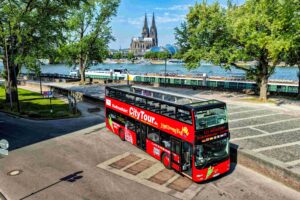
Diesel engine out, electric powertrain in: 18 double-decker sightseeing buses from Willms Touristik have recently been converted from diesel to electric. The modernised buses have been operating in Cologne and other German cities since the spring of 2025. All vehicles are powered by a powerful 145 kW electric motor in combination with a fully automatic Allison T280R transmission.
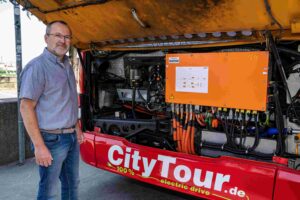
It was important for Sascha Willms to use a robust drive system that can operate under the demanding conditions of a sightseeing bus. “We deliberately decided against a gearless direct drive and instead selected a drive system that has already proven itself in municipal vehicles, such as refuse collection vehicles.”
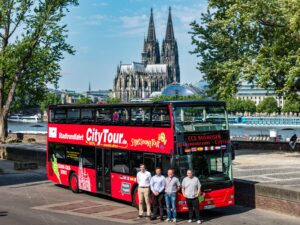
From left to right:
Karsten Flamming, Executive Assistant of Willms Touristik, Christian Bock, Area Sales Manager for Allison Transmission, Sascha Willms, Managing Director at Willms Touristik, Stefan Herzig, driver at Willms Touristik.

Passengers and residents benefit from the significantly reduced noise and pollution levels.
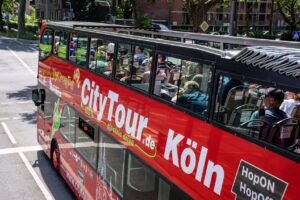
The driving characteristics of the converted double-decker buses differ significantly from those of conventional, diesel-powered buses with manual or automated transmission. Passengers, especially on the upper deck, benefit from the fact that the jerky gear changes that can occur with other transmission technologies are eliminated. This is made possible with Allison’s Continuous Power Technology™.
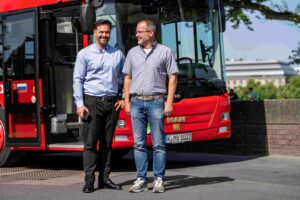
From right to left:
Sascha Willms, Managing Director of Willms Touristik and Christian Bock, Area Sales Manager Allison Transmission, on a test drive in Cologne.
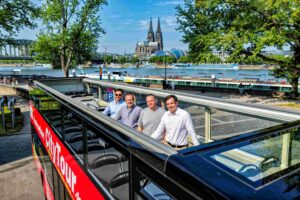
From left to right:
Christian Bock, Area Sales Manager for Allison Transmission, Sascha Willms, Managing Director at Willms Touristik, Stefan Herzig, driver at Willms Touristik, Karsten Flamming, Executive Assistant of Willms Touristik.
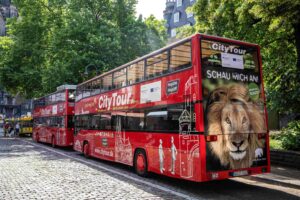
The converted electric buses have a range of around 200 kilometres (approx. 124 miles), which covers the mileage of the daily city sightseeing tours.

The Allison T280R transmission was originally developed for diesel buses. Experts at Banke ApS and DGS adapted it specifically for use in electric buses in order to make optimum use of the electric motor and further increase the efficiency of the overall system.

Allison fully automatic transmissions use a torque converter in place of the traditional dry clutch, which multiplies the engine torque during start-up and acceleration and protects the entire drivetrain from jolts caused by shifting and vibrations.
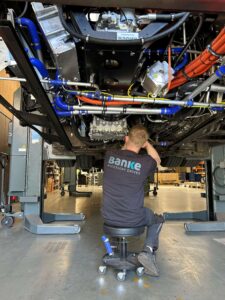
As part of the ‘Retrofit electric mobility in urban public transport’ funding programme’, 18 MAN double-deckers manufactured between 1988 and 2019 were electrified and the diesel engine was replaced with a modern electric drive. The conversion was carried out by Banke ApS, a Danish specialist company, in close cooperation with the Allison authorised distributor DGS Diesel- und Getriebeservice GmbH in Mainz, Germany.